Generative Art: In Theory and in Practice
Chapter 1

For those of you in the class, by now I'd hope you know what this whole "generative art" thing is. To reiterate and put into my own words, I'd explain it like this:
Art comes in many flavors and varieties. You've got different mediums and different styles and movements and so on and so on. This we know. But understanding generative art requires thinking outside the realm of typical artistic motivations. Typical artistic motivations are those such as these: "We want to do art because we want to make something - anything, and for whatever darn reasons we choose." Here's the kicker, ladies and gents: GenArt is interested in not simply making art - GenArt is all about the process. When we make art with pen and paper, do we have a tendency to regulate our movements, or to create a set of rules by which we make the art? Not really, no. This is GenArt: the creation of artistic material through the use of a process - the creation of something where the emphasis lies not in what was made, but how it was created with the tools that be.
I'm usually confident in my explanations, but that was pretty weak, wasn't it? Let's try again, but I'll only use 3 sentences, each sentence must have 1 more word than the previous, and I wont delete wont I type. This is going to be hard. LET'S GO:
GenArt likes to use processes. And by processes, we mean procedures. If you can explain it better, do.
OH, DEAR. That was absolutely awful. Several times I tried to delete the words I began the sentence with but I remembered I had to keep going. (Hence the abrupt ending on the third sentence.) Perhaps I should have began with more words in the first sentence... Well, anyway, I suppose my point was that the three sentences above are somewhat like GenArt. They use processes, but they're also missing something very crucial to GenArt: an element of random.
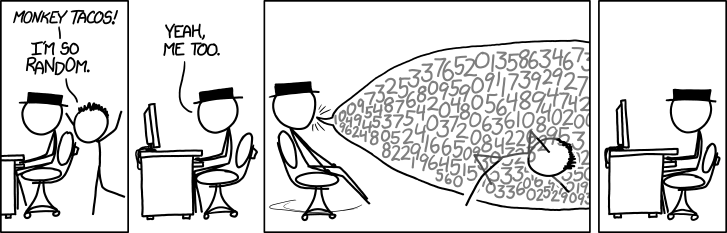
Hopefully you're starting to get the point, because I'd rather not explain it anymore. Let's instead move on to . . . OPINIONS! *evil laughter*
- GenArt is beautiful, and I think it and other forms of digitally created, interactive media will be the emerging art medium that society will fall in love with. This is when you say, "What the heck is he talking about?" DARE I SAY: Let me explain:
- So we got this thing called art. WHOO! Painting and sculpting were the cat's pajamas back in during the Renaissance. Have we had a renaissance since then? Think real hard. Chew on this question if you're not feeling me yet: When was the last time humans got really excited about art, a new medium, a new technique that LITERALLY defined several hundred years where life itself was improved? NOPE
- So what I'm saying is this: We're due for another Renaissance, and guess what? It's going to be digital, ladies and cats. Digital.
- Evolutionary Algorithms are so brilliant I cant even begin to talk about them.

While the context in this image is probably biological, let's just REINTERPRET this to mean a computer programmer is fighting against a figurative representation of evolution/natural selection. (And I've got 7 dollars on the DNA)
- Brian Eno is someone everyone should know. His work with generative music, (which ironically is another name for my favorite genre of music), has changed the face of modern music. I love him, and please listen to the video below and try to tell me why you don't love him too.
In other news, Brian Eno is also the guy who made the Windows 95 Startup sound. I'll let you google that one, but I will post stuff he said talking about it:
The idea came up at the time when I was completely bereft of ideas. I'd been working on my own music for a while and was quite lost, actually. And I really appreciated someone coming along and saying, "Here's a specific problem — solve it."
The thing from the agency said, "We want a piece of music that is inspiring, universal, blah-blah, da-da-da, optimistic, futuristic, sentimental, emotional," this whole list of adjectives, and then at the bottom it said "and it must be 31/4 seconds long."
I thought this was so funny and an amazing thought to actually try to make a little piece of music. It's like making a tiny little jewel.
In fact, I made 84 pieces. I got completely into this world of tiny, tiny little pieces of music. I was so sensitive to microseconds at the end of this that it really broke a logjam in my own work. Then when I'd finished that and I went back to working with pieces that were like three minutes long, it seemed like oceans of time.
- When Matt Pearson described "Man-made marriages" with machines, I couldn't help but get excited. NOW DON'T YOU THINK I'D BE MARRYING A MACHINE. When I say excited, I mean nervous, because this is becoming an issue of surprising complexity. Do you know what RadioLab is? You should, because their podcasts push the boundaries on science, human emotion, and creative storytelling. Hit the link to hear a 30 minute podcast about Talking to Machines or click play below.
This also brings up another distraction. Have you heard about this film? Well, you should at least watch this trailer:
WELL! That was a fun first reading, and it seems like I wasted enough of your time, so . . . if you have any questions about what I posted, any OUTRAGEOUS comments about my blogging techniques, or if you'd simply like to voice your feelings, or perhaps make known your concerns for my sanity: send me a message or post a public comment.

The part on Brian Eno really interested me, especially the last quotation where he describes his experience writing tiny pieces of music. When working with something small, one has to be precise and concise, doing only what is necessary. The simplicity is what makes the piece. And the creativity required is amazing. What I mean to say is that when working under strict confines, sometimes that is when things get really good because people have to be creative to work around them. Then, when given more freedom, the expression of the small work can be expanded--still maintaining its essence though. When given too much freedom/time, it is easy to try to do everything, or to drag something out unnecessarily. Hopefully we can avoid this in our class assignments. I'm not sure where else to go with this, but in short, I like what Eno and you have to say.
ReplyDeleteI like what you're saying that he's saying here. It's so true. Sometimes confining yourself to work with certain limitations can unleash creativity. And we do want to do that in our artwork. Especially at the beginning of this class, you only have a limited set of tools to work with... but there's so much freedom in how you can use them, and you may be forced to do curious things.
DeleteThanks for the post, Jami! You're definitely right about this one - what's the phrase? Freedom in chains or freedom through discipline? I like how Dr. Stonedahl explains it as well - I'm sure I understand why this happens, but I guess it narrows the focus, allowing for more efficient use of the tools available. Maybe this let's one hone in on the details; sometimes approaching a large task can be overwhelming, so breaking it up is the best way to begin.
Delete